
Intelligence in Motion: 2025 Recap & 2026 Predictions
A deep dive into the convergence of AI and crypto, and the launch of the Flora AI Studio.

2025 was the year AI excitement settled into something real.
You could feel the shift in how people worked. The initial rush of discovery evolved into a steady rhythm of creation. Builders got comfortable, and the tools that once felt experimental became a natural part of the flow.
We saw a new standard emerge where users weren’t just asking AI questions, but actually using systems that plan, execute, and ship.
At Flora, we saw this happen in real-time. We spent the year building in public, watching builders interact with our AI bot Sprout, and learning exactly where the gap lies between a "cool demo" and a deployable app.
Here is how we got here, what we saw in the market, and why 2026 belongs to the Flora AI Studio.
The Path to Flora: From infrastructure to AI
Before focusing on AI, we spent years building Esprezzo, an automation platform for crypto infrastructure. In 2025, we took that experience and built our own private cloud to power the next phase of Flora.
The turning point came when we deployed custom MCPs (Model Context Protocols) to connect our internal data and tools. Our engineering velocity spiked, and the realization hit: the interface to compute was changing forever.
We saw a future where builders no longer spin up machines manually. Instead, baseline DevOps is automated through prompting—generating the code and dynamically provisioning the compute needed to run it.
We took our core infrastructure, our private cloud and custom MCPs, and built it into the core of the Flora AI Studio.
2025 Trends: The infrastructure of autonomy
Three major shifts defined the landscape this year and validated our new direction.
1. Model commoditization began
The year started with early releases from ChatGPT, Claude, and Gemini. Capability was concentrated in a handful of large models, and access still felt gated. By the end of 2025, Lightweight and “flash” models reached performance levels comparable to mid 2025 flagship releases at a fraction of the cost. This collapse in the cost-to-capability curve quietly set the stage for what comes next in 2026.
2. Agents replaced chatbots
Teams stopped expecting one model to do everything. The winning architectures were multi-agent systems where distinct roles handled planning, coding, and review. The bottleneck moved from model intelligence to orchestration.
3. Prediction markets became agent inputs
Prediction markets (Kalshi, Polymarket) exploded as high-signal data feeds. Polymarket was referenced in a South Park episode. Kalshi partnered with CNN and CNBC, putting live probabilities directly alongside traditional news coverage.
At the same time, their role started to shift — we saw early systems and agents begin treating real-time probabilities as inputs for decision-making, often trusting price signals over slower, noisier headlines.
4. Stablecoins became the invisible rails
While the market debated prices, stablecoins quietly became the default settlement layer for AI. In 2025, we saw the rise of autonomous wallets, where agents hold their own balances to pay for APIs and compute directly. The "crypto" part disappeared; it just became the fastest way for software to pay software.
Flora in 2025: Building in public
We didn't just watch these trends; we lived them alongside the community.
The Sprout launch
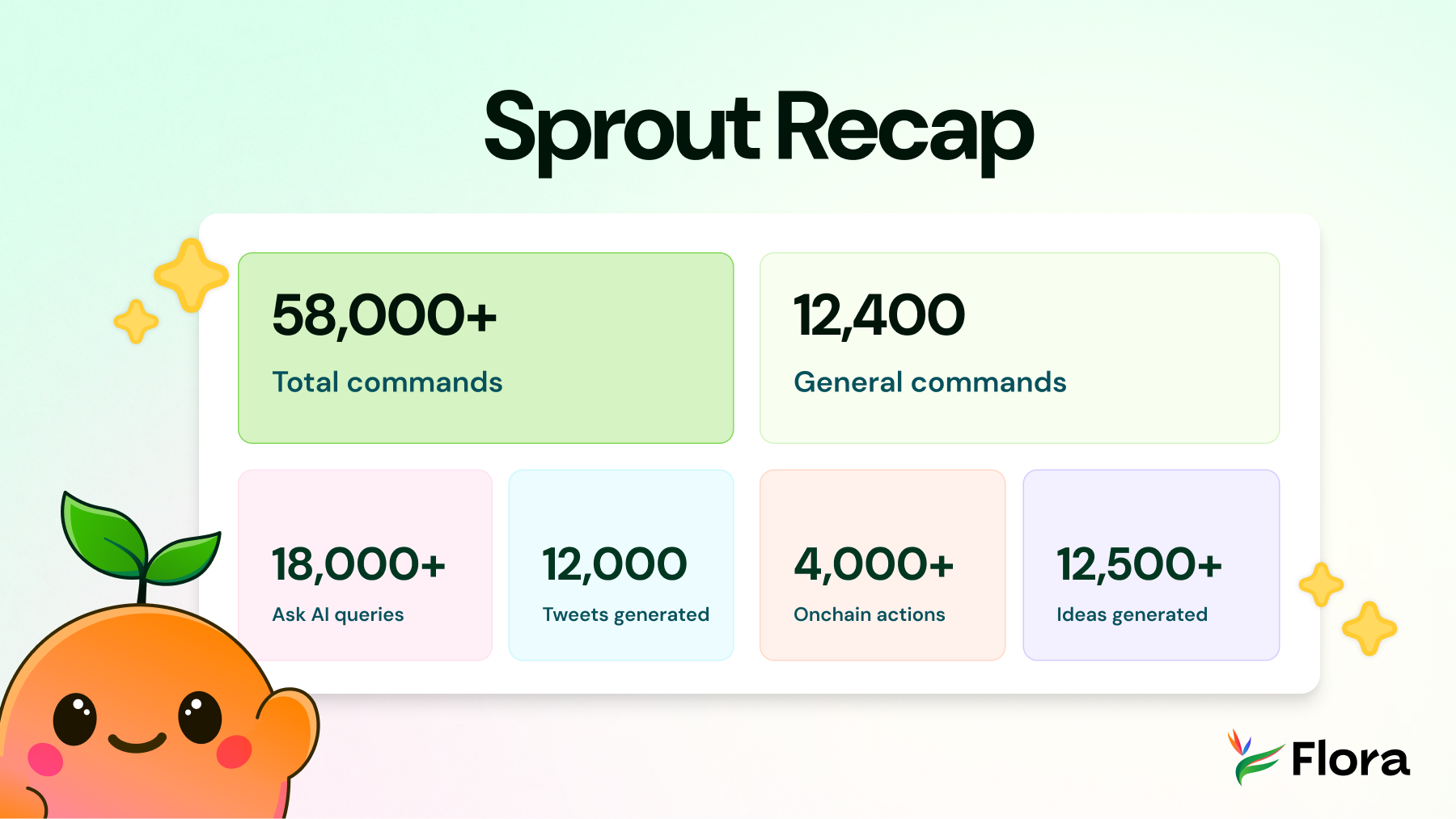
We launched Sprout, our Discord-based AI bot, which gained rapid adoption through gamified roles and incentives. In just over 45 days, Sprout powered 58,000+ total commands including:
- 18,000+ AI queries
- 12,500+ Ideas generated in the Idea Lab
- 12,000+ Tweets composed
- 4,000+ Onchain actions completed
Connecting IRL: Devconnect & "Seed for Thought"
Digital metrics are great, but the signal became even stronger through face-to-face conversations.
We spent the year talking to builders across the ecosystem — from Ethereum’s DevConnect, Zama's FHE House and WalletCon in Buenos Aires, to our Seed for Thought series with leaders from Polygon, Avail, and Growth Terminal.
Across every timezone, the feedback was clear. Generating code has become trivial, but structuring the prompt remains a massive hurdle.
This matched the behavior we saw in our own data. Dropping a vague one-liner is fine in a free sandbox, but in a paid tool, that ambiguity creates real issues. It leads to hallucinated results, wasted credits, and frustrated users. The primary blocker is simply prompting ability.
Builders need a guide to turn ideas into actionable product specs before generating code. This realization defined our roadmap for 2026.
2026 Roadmap: From onboarding to creation
In 2026, we are moving from Discord to a dedicated, browser-based creative environment.
Planning Mode (Q1 2026)
Before you build, you need a blueprint. Planning Mode turns Sprout into your product manager, interviewing you to refine your idea and outputting a comprehensive product spec.
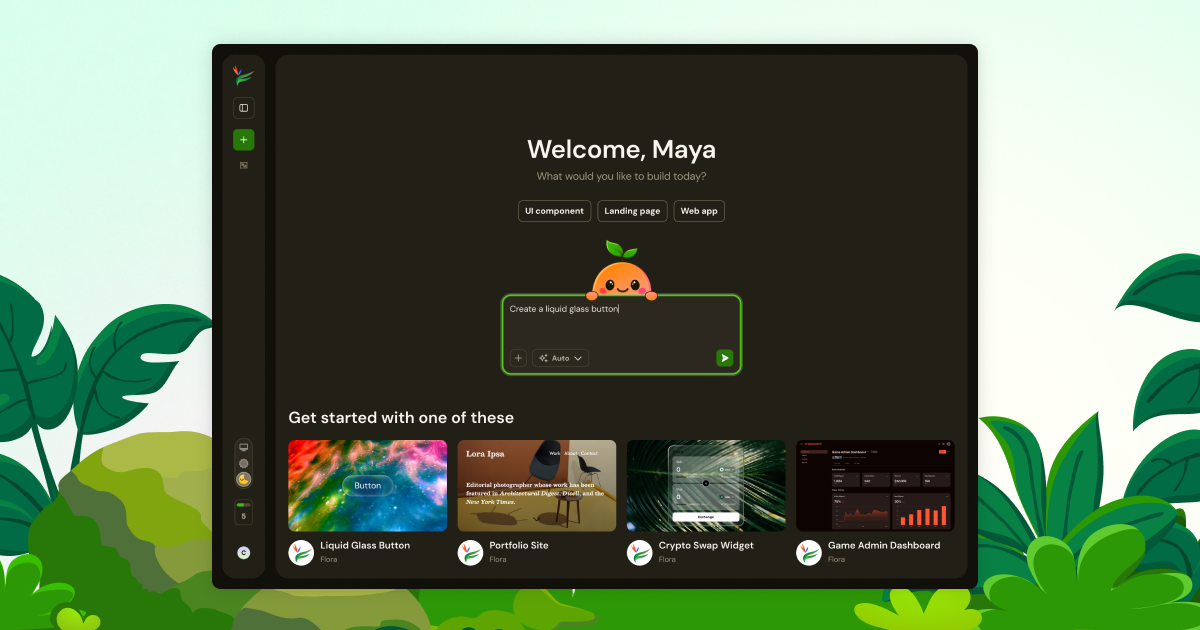
The Flora AI Studio
The flagship product. A dedicated environment where you can:
- Prompt to Product: Turn plans into full-stack web apps
- Iterate Visually: No more copy-pasting code; preview and edit in real-time
- Remix-to-Earn: Share your components and earn when others remix them
Help us build the Studio
We are finalizing the feature set now. If you’ve used tools like Lovable, v0, or Cursor, we want your raw feedback.
(Bonus: We’ll move you up the waitlist for the Studio)
Take the survey2026 Predictions: The year software becomes liquid
Looking ahead, we see the barriers between idea and app dissolving completely.
1. Software becomes disposable
In 2025, we built apps to last. In 2026, the cost of creation will drop so low that we will build Just-in-Time software. Need a dashboard for a weekend event? You’ll describe it, the Flora AI Studio will build it, you’ll use it, and then discard it.
2. Context beats IQ
The Model Wars are over. The most valuable agents won't be the ones with the highest IQ, but the ones with the deepest access to your private context. Builders won't hand that level of access to a generic API wrapper. To build agents that truly know you without exposing you, the sovereignty of a private cloud becomes the only viable path.
3. The hybrid standard wins
The ideological war is over. The winning apps will be hybrid systems: Web2 in the front for speed, Web3 in the back for settlement and verification. As agents handle high-stakes work, cryptographic proof will become non-negotiable.
4. Agents with wallets
Agents will stop hitting paywalls. They will hold their own balances to pay for API keys, compute, and gated data. The "crypto" part will disappear; it will just be software paying software powered by standards like x402.
Closing out the year
Building new things is messy, loud, and exhilarating. Thank you for being part of the journey with us this year.

Whether you’ve been with us since the early Esprezzo days or you just joined the Discord last week, your energy is what keeps this engine running. We’re heads-down finalizing the Studio, and we hope everyone enjoys the holidays. The charts, the feeds, and the notifications will still be there when you get back.
Rest up. We have a lot to build together in 2026 🌱